Pro-Vionic 10 - The Science
Under the Microscope
Most cleaning products ask you to take their word for it. Apply the fluid, wipe the record, trust the result. What you cannot see, what nobody had ever shown you, is what is happening at groove level while the fluid is doing its work.
We decided to show you.
Using a 4K digital microscope at high magnification, we filmed Pro-Vionic 10 being applied to a contaminated vinyl record surface in real time. What you see in the images below is not a laboratory demonstration. It is not a staged test with engineered contaminants. It is a real record, genuinely dirty, cleaned the way most people clean their records: by hand, with a microfibre cloth.
No vacuum record cleaning machine. No ultrasonic bath. No enzyme pre-treatment. Just Pro-Vionic 10 and a cloth.
This matters because the most thorough cleaning methods most audiophiles consider optimal involve vacuum record cleaning machines, ultra-sonic machines, multi-step processes, or enzyme pre-treatments costing hundreds of pounds in equipment. What you are about to see was achieved without any of that.
Their results depend as much on the machine's mechanical extraction as on the fluid itself. Some require enzyme powders mixed fresh per session. Some require three separate steps with separate brushes. What you are about to see was achieved without any of that.
Stage 1 – Before

This is the groove surface before cleaning. What you are looking at is not visible to the naked eye. At this magnification, the grooves run diagonally across the frame, each one a fraction of a millimetre wide, the geometry that your stylus reads to reproduce music.
The bright speckled particles distributed across the groove walls are particulate contamination, fine dust, atmospheric debris, and possibly fingerprint oil residue on the groove surface across several areas. Every one of those particles is in the path of your stylus.
Silica, the most damaging component of common dust, has a Mohs hardness of 7. Vinyl sits at 2.0 to 2.5. Under typical stylus tracking forces, contact pressure on the groove wall can reach 50,000 to over 90,000 psi depending on stylus profile and tracking weight, this pressure differential makes permanent, cumulative groove damage the expected outcome.
This is what you are protecting against.
Stage 2 – Fluid Entry

Pro-Vionic 10 is applied outside the microscope frame and the fluid front enters from the right. Watch the leading edge.
A fluid with high surface tension, plain water, for example, would bead across the groove surface, sitting on top of the groove geometry rather than penetrating it. What you can see here is the opposite: the fluid meniscus is following the groove walls, tracking the geometry precisely, wetting the groove floor and sides as it advances.
This is the non-ionic surfactant doing its primary job. By reducing surface tension below the threshold required to penetrate groove geometry, the fluid reaches the contamination where it actually lives, in the groove, not on top of it. The difference between a fluid that tracks grooves and one that does not is the difference between cleaning the groove and cleaning the area around the groove.
Stage 3 – Active Cleaning

The fluid has now spread across the groove field. The groove geometry is visible through the fluid layer, the iridescent groove walls catching the ring light. The contamination visible in Stage 1 is changing.
The particulate masses that were adhered to the groove walls are loosening. The surfactant molecule has a hydrophobic tail that attaches to oil and organic contamination, and a hydrophilic head that pulls that contamination into the aqueous phase, into the fluid and away from the groove surface. What you are seeing is that process made visible. The contamination is leaving the groove walls and entering suspension in the fluid.
This is why emulsification matters. The contamination is not being diluted or spread around. It is being chemically detached from the vinyl surface and held in the fluid, ready for removal.
Stage 4 – Suspended
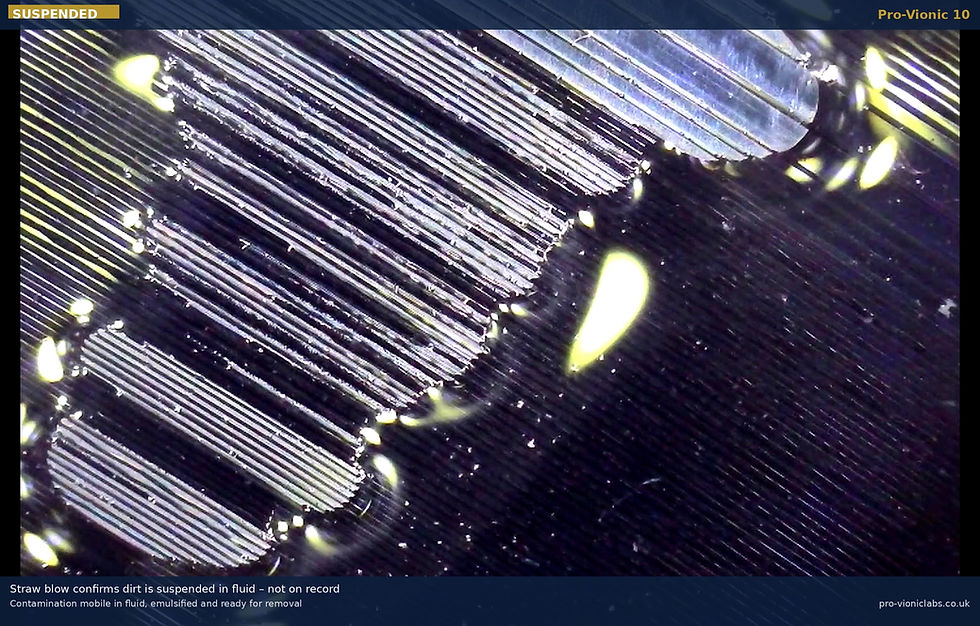
To demonstrate that the contamination was genuinely suspended in the fluid rather than still adhered to the record, we directed a gentle stream of air across the groove surface using a straw.
The result is visible here. The fluid, and the contamination within it, moves in response to the air. The particles are mobile. They are in the fluid, not on the record. The groove surface visible through the disturbed fluid is already substantially cleaner than Stage 1.
This single image is the clearest possible demonstration of what emulsification means in practice. The dirt that was locked into your groove is now suspended and ready to be lifted away completely.
STAGE 5 – Result
.jpg)
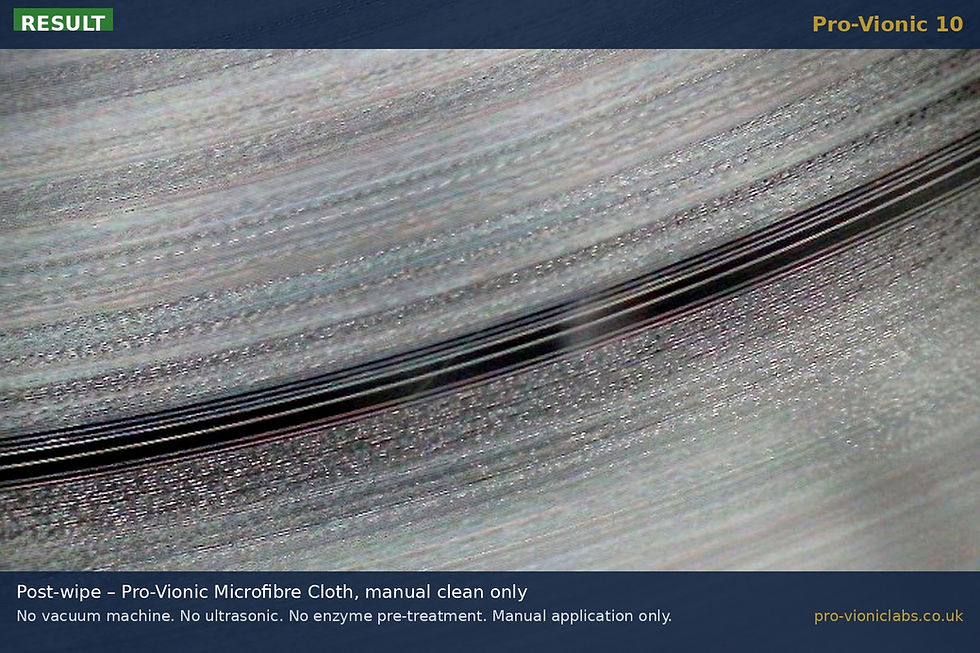
The fluid has been removed using the Pro-Vionic Microfibre Cloth, applied by hand. This image is zoomed out to give you a more complete view of the end result.
Compare this frame with Stage 1. The contamination distributed across every groove in the before image is gone. The groove geometry is now visible as clean, sharp, continuous lines across the full frame. The groove walls, the surfaces your stylus reads, are clear.
This result was achieved with manual application and a microfibre cloth alone. No vacuum machine. No ultrasonic cavitation. No enzyme pre-treatment.
For archival-standard results, a final rinse with Pro-Vionic Ultra-Pure Distilled Water is recommended, removing any remaining trace of surfactant from the groove surface. The result shown here is what Pro-Vionic 10 achieves before that final step.
The groove walls show no surface disruption, no etching, no evidence of chemical interaction with the vinyl matrix. Pro-Vionic 10 is alcohol-free and solvent-free by design. It cleans by emulsification and surface tension reduction, not by chemical attack.
What you have just seen is the surfactant chemistry working.
Most competitor products sold as a concentrate ask you to add your own water: distilled or deionised water from a supermarket, reverse osmosis water from a home filter, water of unknown quality, unspecified purity, and no independent verification.
Silica passes through a standard TDS meter essentially undetected at the pH of cleaning water. A reading of 3 parts per million tells you nothing about silica. Your water can appear analytically clean and still be carrying the one contaminant most likely to cause irreversible groove damage.
What you have just seen is the surfactant chemistry working. But what you cannot see in these images is equally important: what is left behind after the fluid dries.
Most competitor products that use a concentrate, including most competitor products that use a concentrate, asks you to add your own water. Distilled or deionised water from a supermarket. Reverse osmosis water from a home filter. Water of unknown quality, unspecified purity, and no independent verification.
Silica passes through a standard TDS meter essentially undetected at the pH of cleaning water. A reading of 3 parts per million tells you nothing about silica. Your water can appear analytically clean and still be carrying the one contaminant most likely to cause irreversible groove damage.
Pro-Vionic 10 is pre-mixed. The water used is certified distilled water, UK-produced, with a Certificate of Analysis held per batch confirming a typical pH of 5.8, calcium below 0.1 mg/L, and conductivity of 1–2 µS/cm on tested batches.
We are not aware of any other vinyl cleaning product in this category that provides a per-batch Certificate of Analysis as standard.
We are not aware of any other vinyl cleaning product in this category that provides a per-batch Certificate of Analysis as standard. When Pro-Vionic 10 dries on your record, the only thing left behind is the record.
The packaging completes the chain
Ultra pure water is chemically aggressive. Unlike ordinary water it carries no dissolved minerals or buffer compounds that compete for leaching sites, which means it will extract trace contaminants from a plastic container more readily than tap water would. Packaging a certified fluid in plastic risks introducing the very contamination the certification was designed to exclude.
Pro-Vionic 10 is packaged in amber glass bottles. Chemically inert. UV-absorbing. The integrity of the fluid is protected from the moment it leaves production to the moment it contacts your record.
One test. No machine. No compromise.
The images above were taken during a single test session using Pro-Vionic 10, a Pro-Vionic Microfibre Cloth, and a 4K digital microscope. The record was contaminated, cleaned by hand, and examined at magnification before, during, and after the process.
We did not use a vacuum machine because most people do not own one. We did not use enzyme pre-treatment because Pro-Vionic 10 does not require it. We did not cherry-pick the result.
This is what Pro-Vionic 10 does to a dirty record. Under the microscope. By hand.